


The sciencebehind light'shealth effects.

Good light is part of a healthy home. Every window, lamp, and screen is a part of your light environment and has an effect on your biology.

This page covers some basics about light before going into an evaluation of the research to date about light's health effects. We then wrap up with a summary of how Lightwork assesses it in homes.

Last updated
November 2026
Other areas
AirWater
Summary

Four light-related exposures

Light is one of the main signals your body's clock uses to tell time. Cells in the eye that respond most to blue light set the timing of sleep, alertness, and hormones, and they react to far tinier quantities of light than you might think 1.

Many homes have an upside-down lighting environment. Days are dim (thanks to working indoors under weak lights, with light passing through heavily-treated windows), evenings are bright and blue-rich, and the lights flicker 2.

Below are four kinds of light exposure we look at along with the health effects this page covers. Some are positive when done right; others are negative when done wrong.

  1. Exposure 1 · Morning to afternoon

    Daylight

    How much bright light you get during the day. Indoor light is usually far dimmer than daylight, and most of us spend our days inside.

    We suggestGet bright light during the day, outdoors when you can.

    The evidence →
    • 23%fewer children became nearsighted with 40 more minutes outdoors at school 3
    • DepressionSettled
      2.4×the odds of remission from depression with bright light therapy, across 11 trials 4
    • 53%slower functional decline with whole-day bright light in care homes, in a trial 5
  2. Exposure 2 · Evening

    Evening light

    Light in the hours before bed, when ordinary room light can delay your body's clock. Blue-rich light has the biggest impact.

    We suggestIn the hours before bed, keep light low and warm, with as little blue as possible.

    The evidence →
  3. Exposure 3 · Night

    Light at night

    Light in the bedroom while you sleep, from lamps, screens, and nightlights, or from outside through the window.

    We suggestKeep the bedroom as dark as you can while you sleep.

    The evidence →
    • Type 2 diabetesConsistent
      53%higher risk for those with the brightest nights, in 84,790 adults 8
    • 56%higher heart failure risk for those with the brightest nights, in 88,905 adults 9
    • DepressionConsistent
      45%higher odds of depression with light at night, across 19 studies 10
    • CancerUnsettled
      2AIARC rates night shift work as probably carcinogenic 11, but a pooled analysis of 1.4 million women found no link to breast cancer 12
  4. Exposure 4 · All day

    Flicker

    Fast pulsing in a light's output, often too fast to see. It depends on the bulb, its driver, and the dimmer.

    We suggestChoose lights that don't flicker, especially where you spend significant time.

    The evidence →
    • 41%of people with migraine got a headache within 4 hours of LED flicker testing, vs 8% of others 13
    • PerformanceEmerging
      600 Hzflicker, far too fast to see, still slowed reading speed 14
How to read this page

How we grade evidence.

In some cases, the evidence is cut-and-dried, and eliminating a negative exposure or adding a positive one is an obvious choice.

But most situations aren't like that. For those, we believe in the Precautionary Principle. When there's credible signal of risk, the source is in your home, and the fix is simple, our preference is to act early and preventatively instead of waiting for complete scientific consensus. This is especially true if you suspect you might be feeling negative effects that could be caused by a prospective exposure. “No (or uncertain) evidence of harm” is not the same as “evidence of no harm” or “evidence of safety.”

We also believe there's a big gap between the higher certainty required to make changes at a societal level, and the low certainty required to make a simple change yourself and see how you feel, and we're focused on the latter.

And of course, this is all subject to change as the science continues to evolve.

  • Settled
    Shown in trials. Randomized trials in people show the effect, and reviews agree.
  • Consistent
    Large studies agree. Big studies and pooled analyses point the same way, but trials are small or not possible.
  • Emerging
    Early, and growing. Newer or smaller studies agree, and the finding needs to be replicated.
  • Unsettled
    Evidence is split. Different kinds of studies disagree, so we make sure to consider and show both sides.
How it works

The biology of light

Before the studies, it's worth considering the mechanism of action. The eye has cells that report to your body's clock, and the light in your home affects them in specific ways.

The sensor

Your eyes do more than just see

Rods and cones are for seeing. A separate set of cells in the retina, called ipRGCs, reports to your body's clock instead. ipRGCs contain a pigment called melanopsin and respond most strongly to blue light, around 480 nm. In lab studies, the wavelengths that suppressed melatonin most were 446 to 477 nm 1516.

These cells help set the timing of sleep, alertness, and hormone release. They are separate from vision, so a light can look comfortable to you and still send a strong unintentional signal to your clock. Bright daylight has a lot of this blue light. Sunset and flame have very little.

The source

How do bulbs work?

Every light has a spectrum: how much of each color it gives off. An incandescent bulb heats a filament, and its spectrum is smooth, starting low in the violets and blues and rising toward red. An LED works differently. The diode makes one narrow color, so to make white, it is coated in a phosphor that absorbs some of the light and re-emits it at longer wavelengths.

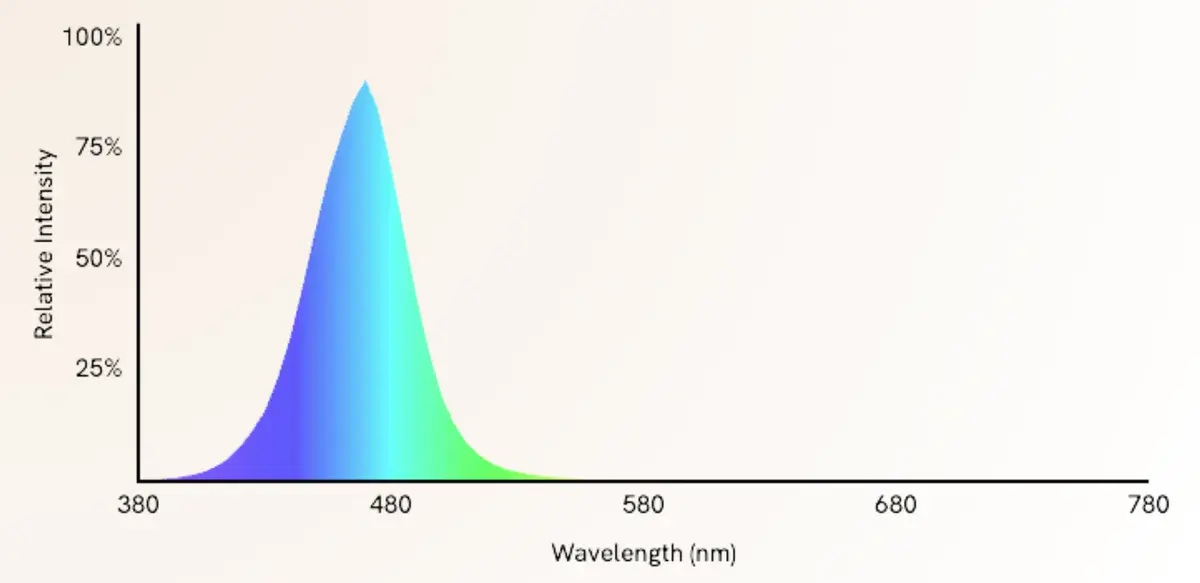
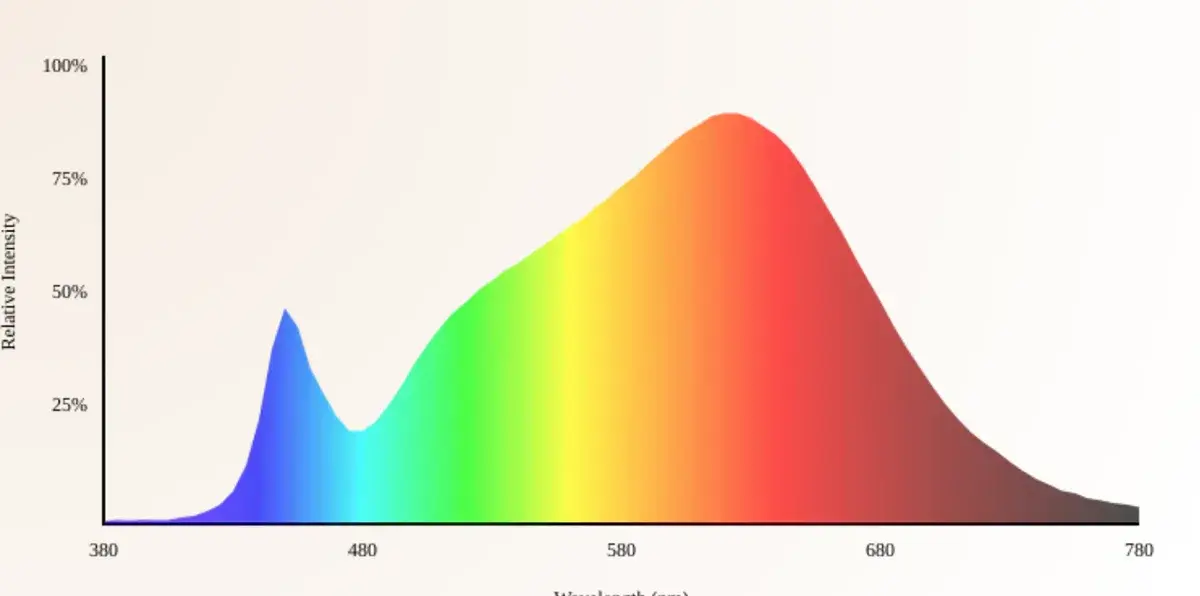
A phosphor can only move light longer, never shorter. White LEDs therefore start with a blue diode, and part of that blue passes straight through, close to where your body clock is most sensitive. That is why a warm-looking LED can still have a blue peak. The color temperature on the box tells you how the light looks. It does not tell you the spectrum (although warmer is typically lower blue light)!

Even a warm-looking LED carries a blue peak

Relative power by wavelength · nm

Warm white LED The light's spectrumWhat the body clock responds to

Looks warm, but starts from a blue diode. A smaller blue peak survives the phosphor, close to where the body clock is most sensitive. The most common bulb in homes, and the one people least suspect.

The colored area is how much light the bulb gives off at each wavelength. The dashed curve is how strongly the body clock responds to each wavelength, peaking in the blue near 480 nm, so the more a spectrum overlaps it, the stronger the signal.

The dose

It takes less light than you'd think.

Brightness is measured in lux. Our eyes adapt, so a lit room looks bright to us even though it holds only a small fraction of the light outdoors. The squares show it at true scale: each one's area is its brightness. Yes: outdoors is often roughly 300 times as bright as indoors during the day!

Melatonin suppression is predicted to start at about 1.5 melanopic lux 1, and after days spent in dim light, the same evening light suppressed melatonin more 17. So the next chart uses a log scale, where each step is ten times brighter, to show where studies found effects (otherwise you'd barely be able to see the lines!).

The orange lines are benefits during the day, the black ones are harms at night.

A bright room is a sliver of daylight

Light levels at true scale: each square's area is its brightness

At true scale

  • Direct sun100,000 lux, approximate
  • Light-therapy box10,000 lux
  • Outdoors, in shade1,000 lux and up

Inside the shade square, magnified

  • Indoors by dayAbout 300 lux
  • Room light while asleep100 lux
  • Half the melatonin effect24.6 lux
  • A bedroom at night5 lux

Each square's area is its brightness. Everything indoors fits inside the small outdoor-shade square, shown magnified on the right.

Studies found effects across ten thousandfold

Light level where each study found an effect, in lux

By day: linked to benefitAt night: linked to harm
Indoors by day 300Direct sun 100,000
Where melatonin suppression beginsPredicted from lab data 1
1.5 melanopic lux
Poor sleep in older adultsA dim bedroom at night 18
3 lux
New depression and diabetes in older adultsA bedroom at night 19 20
5 lux
Half the maximum melatonin suppressionAdults 21
24.6 lux
77.5% melatonin suppression in preschoolersAn hour of light before bed 7
5 to 40 lux
Higher insulin resistance the next morningOne night of room light while asleep 22
100 lux
Melatonin onset delayed in 99% of peopleRoom light before bed 6
Under 200 lux
Slower cognitive decline in care homesBright indoor light all day 5
1,000 lux
Less nearsightedness in childrenOutdoors, even in shade 23
1,000+ lux
Depression treated in a trialA light-therapy box, 30 minutes each morning 24
10,000 lux
The flicker

Why lights flicker.

Household power in the U.S. alternates 60 times a second, so a light can pulse 120 times a second. An incandescent filament stays hot between pulses, so its output barely dips. An LED runs on direct current, so every bulb has a small power supply called a driver. A good driver smooths the pulsing out, but a cheap one (most of them) passes it through. Many LEDs also dim by switching on and off rapidly, called PWM, which can add flicker.

We measure flicker two ways. Flicker percentage compares the brightest and dimmest moments: (max − min) ÷ (max + min). Flicker index is the share of light above the average. Our target is 10% or less, and above 20% is high.

Some lights hold steady; others pulse 120 times a second

Light output over 25 milliseconds, with flicker percentage

Incandescent

The filament stays hot between pulses.

Well-driven LED

A good driver smooths the current.

Typical LED

A basic driver lets the pulsing through.

Dimmed LED

Switched on and off to look dimmer.

025 milliseconds
Exposure 1 · Daytime

Daylight.

Good light exposure by day helps you at night. Most of us get too little light during the day, and this is where the evidence is strongest.

Settled

Children's eyes

9.1pointsfewer children became nearsighted over 3 years with 40 extra minutes outdoors at school 3

In a randomized trial of 1,903 first-graders, one extra 40-minute outdoor class a day cut new myopia over three years from 39.5% to 30.4% 3. A second school trial found that outdoor light of 1,000 lux or more, even in shade, protected against rapid progression 23. Across 25 studies, outdoor time prevented new myopia 25.

Key studies3 studies
3He et al. (2015)JAMAPaper ↗One added 40-minute outdoor class per day reduced 3-year myopia incidence from 39.5% to 30.4% (difference minus 9.1 points).Cluster RCT, 12 schools, n=1,903 first-graders, 3 years.
23Wu et al. (2018)OphthalmologyPaper ↗The outdoor program reduced myopic shift (0.35 D vs 0.47 D) and cut risk of rapid progression by 54% (OR 0.46); exposures of 1,000 lux or more for longer periods were protective.Cluster RCT, 16 schools, n=693 first-graders in Taiwan, 1 year.
25Xiong et al. (2017)Acta OphthalmolPaper ↗Outdoor time protected against incident myopia (trials RR 0.54; cohorts RR 0.57) and reduced myopic shift by 0.30 D over 3 years, but did not slow progression in children already myopic.Meta-analysis of 25 studies.

Counterpoints. This is outdoor daylight, far brighter than indoor light, so it isn't evidence about bulbs. It prevented myopia but didn't slow it in children already nearsighted 25.
Settled

Mood

2.4×the odds of remission from non-seasonal depression with bright light therapy, across 11 trials 4

Bright light is an established treatment beyond winter depression. In a placebo-controlled trial, 30 minutes of 10,000 lux each morning beat placebo, and worked best alongside an antidepressant 24. In 400,000 UK adults, each extra hour of daylight outdoors was associated with lower odds of depression and fewer insomnia symptoms 26, and in 86,772 people with light sensors, brighter days were associated with less depression 27.

Note, however, that many "light therapy lamps" that advertise 10,000 lux or similar are not actually that bright — or, more commonly, they are, but only if you put your face right next to them (which nobody does). Read the specs!

In offices, blue-enriched daytime light improved alertness, mood, and concentration, and even subjective sleep that night 28. The blue that hurts in the evening helps in the morning.

Key studies5 studies
4Menegaz de Almeida et al. (2025)JAMA PsychiatryPaper ↗Bright light therapy increased remission (40.7% vs 23.5%; OR 2.42) and response (60.4% vs 38.6%; OR 2.34) as add-on treatment.Meta-analysis of 11 RCTs, 858 patients. Limits: Trials vary in diagnosis and adjunct treatment; clinical light therapy, not ordinary household lighting.
24Lam et al. (2016)JAMA PsychiatryPaper ↗10,000 lux light for 30 min each morning was superior to placebo (d=0.80), and light plus fluoxetine was best (d=1.11; remission 58.6%), while fluoxetine alone was not superior to placebo.Double-blind, placebo and sham-controlled RCT, n=122, 8 weeks. Limits: A clinical light-therapy protocol, not ordinary household lighting.
26Burns et al. (2021)J Affect DisordPaper ↗Each additional hour outdoors in daylight was associated with lower odds of lifetime major depression and antidepressant use, less low mood, fewer insomnia symptoms, and less frequent tiredness.UK Biobank, about 400,000 adults, cross-sectional plus longitudinal.
28Viola et al. (2008)Scand J Work Environ HealthPaper ↗Daytime blue-enriched light improved alertness, positive mood, performance, concentration, and eye discomfort, reduced daytime sleepiness, and improved subjective sleep quality.Crossover field intervention, 94 office workers, 4 weeks each of 17,000 K vs 4,000 K light.
29Legenbauer et al. (2024)JAMA PsychiatryPaper ↗Bright-light therapy added to intensive inpatient treatment did not outperform placebo red light for depressive symptoms.Multicentre placebo-controlled randomized trial; 227 adolescents randomized; 224 in intention-to-treat analyses. Limits: Specific inpatient population and four-week protocol; follow-up attrition was substantial.

Counterpoints. Light therapy uses very bright light, not ordinary bulbs, and doesn't help everyone: in adolescent inpatients it did no better than placebo light 29.

Settled

Aging and the brain

53%slower functional decline with whole-day bright light in care homes, in a randomized trial 5

In care homes, raising whole-day light to about 1,000 lux, versus about 300, slowed cognitive decline, cut depressive symptoms by 19%, and slowed functional decline by 53% over an average of 15 months 5. Across 24 randomized trials in people with dementia, light therapy improved sleep, mood, agitation, and cognition 30. A 2026 trial installed tailored lighting at home for people with mild cognitive impairment and found better memory scores and sleep than with placebo light 31.

In UK Biobank, the brightest days predicted lower mortality, with hazard ratios as low as 0.66, just as the brightest nights predicted higher mortality 32.

Key studies4 studies
5Riemersma-van der Lek et al. (2008)JAMAPaper ↗Whole-day bright light (about 1,000 lux) vs dim (about 300 lux) slowed cognitive decline (0.9 MMSE points, a relative 5%), reduced depressive symptoms by 19%, and slowed functional decline by 53%.Long-term double-blind 2x2 factorial RCT, n=189 in 12 care facilities, mean 15 months.
30Aini et al. (2024)Am J Geriatr PsychiatryPaper ↗Light therapy improved sleep quality (g=0.60), sleep efficiency (g=0.31), depression (g=minus 0.46), agitation (g=minus 0.65), and cognition (g=0.39).Meta-analysis of 24 RCTs, 1,074 participants.
31Li et al. (2026)J Appl GerontolPaper ↗Active light produced greater improvement in ADAS-Cog memory scores (p=0.035) and better sleep percent and wake after sleep onset than placebo light.Placebo-controlled RCT, n=61 people with MCI, 24 weeks of home lighting.
32Windred et al. (2024)PNASPaper ↗Brightest nights (90 to 100th percentile) had aHR 1.21 to 1.34 for all-cause mortality, while brightest days had aHR 0.66 to 0.83, vs the darkest 50%; effects were largest for cardiometabolic death.UK Biobank prospective cohort, n=88,905, mean 8 years follow-up, 3,750 deaths. Limits: Observational; daytime light also reflects outdoor activity and health. Substantial participant overlap with other UK Biobank papers.

Counterpoints. Bright days also reflect time outdoors and overall health, so the mortality link is observational. The trials are the stronger evidence, and they used more light than most homes have.

What we suggest

Bright days. Spend time outdoors in daylight. Even shade is far brighter than indoors. Inside, use bright, full-spectrum light in the rooms where you spend the day, like an office.

Exposure 2 · Evening

Evening light.

In the hours before bed, ordinary room light can delay your body's clock, and blue-rich light does it most. This is very well-established research, and easy to act on.

Settled

Sleep and the body clock

99%of people had melatonin onset delayed by ordinary room light before bed 6

Room light under 200 lux before bedtime delayed melatonin onset in 99% of people and shortened the body's melatonin duration by about 90 minutes 6. In a randomized crossover trial, reading on a light-emitting e-reader before bed meant taking longer to fall asleep, less melatonin, a later clock, and lower alertness the next morning than reading a printed book 33.

People differ enormously: in one dose-response study, individual sensitivity ranged from 6 to 350 lux 21. An international expert consensus now sets targets for indoor light by day, in the evening, and at night 34.

Key studies6 studies
6Gooley et al. (2011)J Clin Endocrinol MetabPaper ↗Compared with dim light (<3 lux), room light (<200 lux) before bedtime delayed melatonin onset in 99% of people and shortened melatonin duration by about 90 min; room light during usual sleep hours suppressed melatonin by more than 50% in 85% of trials.Retrospective analysis of controlled lab protocols, n=116 healthy adults 18 to 30. Limits: Melatonin is a physiological endpoint, not a disease outcome.
33Chang et al. (2015)PNASPaper ↗EReader use led to longer time to fall asleep, less evening sleepiness, reduced melatonin, later circadian timing, and reduced next-morning alertness.Randomized crossover lab study, light-emitting eBook vs printed book before bed. Limits: Long nightly reading exposures under controlled conditions; device behavior and brightness also matter.
21Phillips et al. (2019)PNASPaper ↗Half of maximal melatonin suppression occurred at just 24.6 lux (group level); 10, 30, and 50 lux delayed melatonin onset by 22, 77, and 109 min; individual ED50 ranged from 6 lux to 350 lux.Within-subject lab dose-response study, n=55 adults aged 18 to 30, 10 to 2,000 lux for 5 h in the evening. Limits: Surrogate hormonal response; controlled light history and exposure duration differ from daily life.
34Brown et al. (2022)PLoS BiolPaper ↗Provides melanopic EDI targets for day, evening, and night indoor light, based on circadian, neuroendocrine, and alerting dose-response evidence.International expert consensus (18 authors). Limits: Guideline, not an independent outcome study; recommendations are for adults.
35Chellappa et al. (2013)J Sleep ResPaper ↗Sleep structure did not differ, but 6500 K light significantly reduced slow-wave activity in the first sleep cycle compared with warmer light.Lab study, n=30, 2 h evening light at 6500 K vs 2500 K vs 3000 K. Limits: Small acute study; EEG changes are not equivalent to clinically important insomnia.
2Wright et al. (2013)Curr BiolPaper ↗Modern built environments meant less daytime sunlight, more light after sunset, and a delayed clock; with natural light only, biological night began near sunset, and late chronotypes shifted the most.Field study, a week of summer camping with only natural light vs modern electrical lighting. Limits: Small nonrandomized camping study changes activity and daily behavior as well as light.

Counterpoints. Melatonin and clock timing are physiological measures. They show the clock responds to household light; on their own, they don't show long-term disease.

Emerging

Children's body clocks

77.5%melatonin suppression in preschoolers after an hour of light at just 5 to 40 lux 7

Young children appear far more sensitive than adults. In 3 and 4 year olds, an hour of light before bed suppressed melatonin at every level tested, and in 62% of children it stayed below half its usual level for at least 50 minutes after lights out 7. Children in early puberty respond more than older teens 36.

Warm light isn't neutral. At 20 lux, cooler 5,000 K light suppressed more melatonin than 2,700 K, but both delayed children's clocks 37. And nightlights are brighter to the body clock than they look: of 25 popular models, only 3 consistently stayed below 5 melanopic lux at the source 38.

Key studies5 studies
7Hartstein et al. (2022)J Pineal ResPaper ↗Melatonin was suppressed 69% to 99% (mean 85%) across all intensities, even at 5 to 40 lux (77.5%), and stayed below 50% of baseline for at least 50 min after lights off in 62% of children.In-home experimental protocol, n=36 children aged 3 to 4.9, 1 h light at one of 15 levels (5 to 5,000 lux) before bedtime.
38Glickman et al. (2026)NPJ Biol Timing SleepPaper ↗Only 3 of 25 products consistently stayed below 5 lux melanopic EDI at source level; under typical use, 14 of 25 stayed below 5 lux on at least one setting, mostly red-toned, dim, and placed far from the bed.Spectral measurement of 25 popular nightlights (79 settings), source-level and simulated bedroom.
36Crowley et al. (2015)J Clin Endocrinol MetabPaper ↗Early and mid-pubertal adolescents showed greater evening melatonin suppression at 15, 150, and 500 lux (9%, 26%, 37%) than late pubertal adolescents.Lab study, 67 adolescents aged 9 to 16, 15 to 500 lux.
37Hartstein et al. (2025)Journal of Biological RhythmsPaper ↗At 20 photopic lux, 5,000 K light suppressed melatonin more than 2,700 K; both conditions delayed circadian timing.Counterbalanced within-child crossover; 10 children aged 3.0–5.9 years. Limits: Very small study; phase-delay difference between spectra was small and clinical sleep outcomes were not established.
39Akacem et al. (2018)Physiological ReportsPaper ↗One hour of approximately 1,000 lux before bedtime strongly suppressed melatonin, persisting after the exposure ended.Within-child controlled light exposure; 10 children aged 3–5 years. Limits: Small experiment following dim-light adaptation; did not measure subsequent sleep disruption directly.

Counterpoints. These are small studies, 10 to 67 children, measuring melatonin rather than long-term health. But it is reasonable to suspect broader effects.

What we suggest

Dim, warm evenings. After dark, switch from overhead lights to lamps below eye level, and keep them dim. Choose bulbs without a blue peak: incandescent or amber, or LEDs made for evening use by reputable, health-aware brands.

Exposure 3 · Night

Light at night.

While you sleep, light in the bedroom matters. In a trial, one night under room light changed metabolism. Large, newer studies link brighter nights to diabetes, heart disease, and depression.

People who slept in brighter light had higher risk

UK Biobank adults, light measured on the wrist for a week, followed for 8 to 9.5 years

Darkest half of nights. The baseline: their risk is set to 100.Brightest tenth of nights. Their risk of each condition on the same scale.
Darkest half of nights
100
Baseline
Heart failure
156
+56%
Type 2 diabetes
153
+53%
Heart attack
147
+47%
Death from any cause
up to 134
+34%
Coronary artery disease
132
+32%
Atrial fibrillation
132
+32%
Stroke
128
+28%

Death from any cause is the top of a reported range, 121 to 134 9832.

Consistent

Metabolism and type 2 diabetes

53%higher type 2 diabetes risk with the brightest nights, in 84,790 adults 8

In a randomized lab study, one night of sleeping under 100 lux of room light raised night-time heart rate and next-morning insulin resistance, compared with sleeping in near darkness 22.

At population scale, risk climbed step by step: diabetes risk was 29%, 39%, and 53% higher across progressively brighter nights, independent of genetic risk 8. A 2026 meta-analysis of 645,010 people found the strongest link for light indoors 40, and an older-adult cohort found more diabetes with bedroom light as low as 5 lux 20.

Key studies6 studies
22Mason et al. (2022)PNASPaper ↗One night of sleeping in 100 lux room light raised nighttime heart rate, lowered heart rate variability, and increased next-morning insulin resistance (HOMA-IR up about 15% vs about 4% down in the dim group) compared with sleeping in <3 lux.Randomized parallel-group lab study, n=20 healthy young adults. Limits: Small, one-night study; measured short-term markers, not incident diabetes or heart disease.
8Windred et al. (2024)Lancet Reg Health EurPaper ↗Compared with dark nights, diabetes risk rose stepwise with brighter nights (HR 1.29, 1.39, and 1.53 for the 50 to 70th, 70 to 90th, and 90 to 100th percentiles), independent of polygenic risk.UK Biobank prospective cohort, n=84,790 with one week of wrist light sensing, 1,997 incident cases over about 8 years. Limits: One week of wrist measurements; residual confounding and cohort selection remain. Overlaps other UK Biobank light analyses.
40Zhang et al. (2026)Front Public HealthPaper ↗Light at night was associated with higher diabetes risk (pooled OR 1.31), with the strongest link for indoor light (OR 1.66, 95% CI 1.15 to 2.39).Meta-analysis of 6 observational studies (645,010 participants).
20Obayashi et al. (2020)Sleep MedPaper ↗Average bedroom light of 5 lux or more was associated with higher diabetes incidence (IRR 3.74, 95% CI 1.55 to 9.05); still significant at a 3 lux cutoff (IRR 2.74).Prospective cohort, n=678 older adults, bedroom light meters, median 42 months follow-up.
41Kim et al. (2023)SleepPaper ↗Any light during the darkest 5 hours was associated with obesity (OR 1.82), diabetes (OR 2.00), and hypertension (OR 1.74), but not high cholesterol.Cross-sectional, n=552 community-dwelling US adults aged 63 to 84, 7-day actigraphy.
42Park et al. (2019)JAMA Intern MedPaper ↗Sleeping with a TV or light on in the room was associated with gaining 5 kg or more (RR 1.17) and incident obesity (RR 1.33) compared with no light.Sister Study cohort, n=43,722 US women, mean 5.7 years follow-up. Limits: Observational; light and follow-up weight were self-reported.

Counterpoints. The trial was 20 young adults for one night. The cohorts measured light for a week, and associations can't prove that changing the light prevents diabetes.

Emerging

The heart

56%higher heart failure risk with the brightest nights, in 88,905 adults 9

The largest objective study of night light and heart disease followed 88,905 adults for 9.5 years. The brightest nights were linked to more coronary artery disease, heart attack, heart failure, atrial fibrillation, and stroke, after accounting for genetics and lifestyle, with stronger associations in women and younger people 9.

Cardiac MRI in the same cohort found poorer heart structure and function with more night light 43. In older adults, bedroom light of 5 lux or more was linked to higher night-time blood pressure 44 and faster thickening of the carotid artery wall 45.

Key studies4 studies
9Windred et al. (2025)JAMA Netw OpenPaper ↗The brightest nights (91st to 100th percentile) vs dark nights were associated with higher risk of coronary artery disease (aHR 1.32), myocardial infarction (1.47), heart failure (1.56), atrial fibrillation (1.32), and stroke (1.28), robust to polygenic risk and lifestyle.UK Biobank prospective cohort, n=88,905 with wrist light sensors, 9.5 years of records. Limits: Observational; overlaps UK Biobank diabetes and mortality datasets.
43Dai et al. (2026)European Heart JournalPaper ↗Higher nighttime light exposure was associated with adverse ventricular and atrial structure/function and greater subsequent cardiovascular risk.Prospective cohort with cardiac MRI; 11,071 UK Biobank imaging participants; 73,286 in outcome analyses. Limits: Observational mediation is not causal proof; shared UK Biobank exposure source rather than independent replication.
44Obayashi et al. (2014)Chronobiol IntPaper ↗Bedroom light of 5 lux or more was tied to higher nighttime systolic BP (120.8 vs 116.5 mmHg) and diastolic BP (70.1 vs 67.1 mmHg).Cross-sectional, n=528 older adults, bedroom light meters plus ambulatory BP.
45Obayashi et al. (2019)Environ IntPaper ↗The highest bedroom light quartile showed significantly greater progression in mean carotid intima-media thickness (adjusted beta 0.028 mm) than the lowest quartile, independent of obesity, smoking, hypertension, and diabetes.Longitudinal cohort, n=989 older adults, median 34 months follow-up.

Counterpoints. These are observational, and the largest come from one dataset, so they await independent replication.

Consistent

Mood and mental health

45%higher odds of depression with light at the bedside at night, across 19 studies 10

A 2025 meta-analysis of 556,861 people linked light at night to depression. The association was strongest for light measured at the bedside or on the wrist, weaker for outdoor light observed and estimated from satellites 10. In 86,772 people wearing light sensors, more night light was associated with more depression, anxiety, and self-harm 27. In older adults followed for two years, bedroom light of 5 lux or more predicted new depressive symptoms 19.

Key studies5 studies
10Deprato et al. (2025)Sci Total EnvironPaper ↗Light at night was associated with depression prevalence (OR 1.18), with stronger associations for bedside (OR 1.45) or wrist-measured indoor light (OR 1.30) than satellite outdoor light (OR 1.10); also bipolar disorder (OR 1.19) and anxiety (OR 1.10).Meta-analysis of 19 studies, 556,861 people.
27Burns et al. (2023)Nature Mental HealthPaper ↗Greater night light was associated with higher risk of major depression, generalized anxiety, PTSD, psychosis, bipolar disorder, and self-harm; greater day light was independently associated with lower risk of depression, PTSD, psychosis, and self-harm.UK Biobank cross-sectional, n=86,772 with wrist light sensors. Limits: Cross-sectional directionality is unresolved; illness can change sleep, activity and light exposure.
19Obayashi et al. (2018)Am J EpidemiolPaper ↗Average bedroom light of 5 lux or more was associated with higher risk of new depressive symptoms (HR 1.89; 1.72 after full adjustment).Prospective cohort, n=863 older adults without depression at baseline, median 24 months.
46Chen et al. (2024)Environ Health Prev MedPaper ↗Each 1 lux increase in indoor night light was associated with a 3.29% increase in depression risk.Meta-analysis of 7 studies, 560,219 participants.
47Esaki et al. (2022)Acta Psychiatr ScandPaper ↗Bedroom light of 3 lux or more was associated with manic or hypomanic relapse (HR 2.54; 2.17 after propensity adjustment); depressive relapse was not affected.Prospective cohort, n=172 outpatients with bipolar disorder, 7 nights of bedroom photometry, 2-year follow-up.

Counterpoints. The largest light-sensor study is cross-sectional, and poor mental health can itself lead to more light at night.

Unsettled

Cancer and light at night

2AIARC's classification of night shift work: probably carcinogenic to humans 11

Because light at night suppresses melatonin, researchers have long asked whether it affects cancer. IARC classifies night shift work as probably carcinogenic, largely on animal evidence 11, and pooled studies link outdoor light at night to a modestly higher breast cancer risk 4849.

The other side is strong too. A pooled analysis of 1.4 million women found no link between night shift work and breast cancer 12, and the link for light indoors at night was positive but not statistically significant 49.

Points to a risk

Studies3 studies
11IARC (2019)Lancet OncolPaper ↗Classified night shift work as probably carcinogenic to humans (Group 2A), largely on limited human and sufficient animal evidence.IARC expert working group evaluation.
48Urbano et al. (2021)Int J Health GeogrPaper ↗Highest vs lowest light at night RR 1.11 (95% CI 1.07 to 1.15), similar for indoor and outdoor, slightly stronger in premenopausal women (RR 1.16).Dose-response meta-analysis of 17 studies.
49Palomar-Cros et al. (2024)Sci Total EnvironPaper ↗Outdoor light at night was associated with breast cancer (RR 1.12, 95% CI 1.03 to 1.23); indoor light (RR 1.07) and prostate (RR 1.43) were positive but not significant.Systematic review of 28 studies (2.5 million people), meta-analysis of 20 breast and 2 prostate studies.

Points the other way

Studies1 study
12Travis et al. (2016)J Natl Cancer InstPaper ↗Million Women Study, EPIC-Oxford, and UK Biobank plus meta-analysis of 10 prospective studies (1.4 million women) found no link between night shift work and breast cancer (RR 0.99, 95% CI 0.95 to 1.03), even for 30+ years.

Counterpoints. This research is about shift work and outdoor light measured from satellites, not bedroom lamps.

What we suggest

Dark nights. Make the bedroom as dark as you can, or wear an eye mask. A week of sleeping in one improved next-day learning and alertness 50. If you need a nightlight, choose a dim, red-toned one and place it far from the bed 38.

Exposure 4 · All day

Flicker.

Many lights flicker faster than you can see, and flicker is linked to headaches and eyestrain. Whether a light does depends on the bulb, its driver, and the dimmer, and you often can't tell just by looking at it.

Consistent

Headaches, eyestrain, and migraine

41%of people with migraine reported a headache after LED flicker testing, vs 8% of others 13

Some LED systems modulate their light far more deeply than older sources, while others don't flicker at all 51. In a double-blind office trial, replacing flickering fluorescent lighting with high-frequency lighting more than halved headaches and eyestrain 52.

An IEEE standard sets frequency-dependent flicker limits to reduce the risk of headaches, eyestrain, and seizures 53, and flashing light can provoke seizures in people with photosensitive epilepsy 54.

Key studies5 studies
52Wilkins et al. (1989)Lighting Research and TechnologyPaper ↗Headaches and eyestrain were more than halved under high-frequency lighting.Double-blind crossover in offices, 100 Hz flicker (43% to 49% modulation) vs high-frequency ballasts (about 32 kHz, under 7% modulation). Limits: Legacy fluorescent technology; effect concentrated in susceptible workers.
13Miller et al. (2024)Lighting Research and TechnologyPaper ↗People with migraine saw phantom arrays more and were more sensitive at higher frequencies; in the 4 h after testing, 41% of the migraine group reported a headache vs 8% of the others.Lab study, n=55 (25 with migraine), 85 LED modulation waveforms.
51Miller et al. (2022)Lighting Research and TechnologyPaper ↗Some LED systems produce temporal light modulation causing severe unwanted effects while others produce none; LEDs can produce much deeper modulation than older sources and are more likely to cause the phantom array effect.Narrative review (US DOE-funded).
53IEEE Std 1789 (2015)IEEE recommended practicePaper ↗Sets frequency-dependent limits on LED modulation to reduce risk of headaches, eyestrain, and seizures.Standards body recommended practice.
54Fisher et al. (2005)EpilepsiaPaper ↗Photosensitivity occurs in about 0.3% to 3% of people; seizures from light affect about 1 in 4,000 people aged 5 to 24; 15 to 25 Hz flashing is most provocative (range 1 to 65 Hz).Expert consensus review.

Counterpoints. The landmark trial used older fluorescent lighting, and no single flicker percentage has been validated as a health threshold.

Emerging

Reading and performance

600Hzflicker, far too fast to see, still slowed reading speed 14

Flicker can affect how well you see and think, even when you can't see it. In two controlled experiments, reading was slowest under flicker at both 60 and 600 Hz, and 600 Hz is too fast to consciously notice 14. People sensitive to pattern glare responded differently even to short exposures 55.

In a randomized lab experiment, people rated high-frequency lighting, which doesn't visibly flicker, as more pleasant, and did better at problem-solving under it 56.

Key studies3 studies
14Laycox et al. (2024)PerceptionPaper ↗Reading was slowest under 60 Hz and 600 Hz flicker; text patterns and visual sensitivity also influenced performance.Two controlled LED-light experiments; Adults grouped by pattern-glare sensitivity. Limits: Measures task performance and visual sensitivity, not disease.
55Veitch and Miller (2024)LEUKOSPaper ↗Sensitivity groups responded differently to temporal light modulation despite short exposures.Subgroup reanalysis of experimental data; Participants with high versus low pattern-glare sensitivity. Limits: Reanalysis of previously presented data; short exposures and restricted visual field.
56Knez (2014)Consciousness and CognitionPaper ↗High-frequency lighting was rated more pleasant and was associated with better problem-solving performance.Randomized laboratory experiment; Human participants exposed to fluorescent lighting conditions. Limits: Small laboratory study with older fluorescent technology.

Counterpoints. These are short lab experiments, one with older fluorescent lighting. They measure performance in the moment, not lasting harm.

What we suggest

Steady light. Choose bulbs that publish low flicker (or, better, are independently tested for the same), and check dimmers. For a rough screen, film a light for two seconds in your phone's slow-motion mode. Dark bands rolling through the video are a warning sign. But a clean video doesn't prove a light is steady; for that you need a flicker meter or a spectrometer. Many high end bulbs flicker faster than the slow-motion will capture.

Our approach

We measure every light in your home.

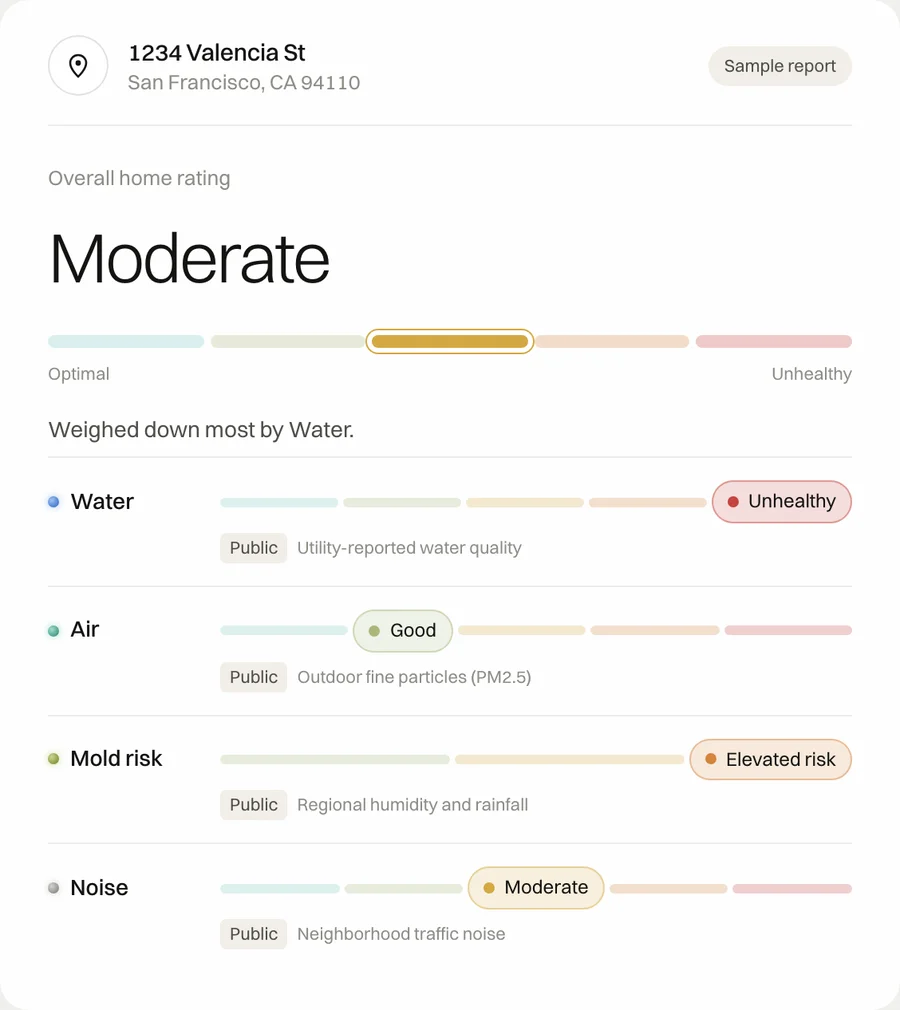
A bulb can look warm and still have a blue peak. A fixture can look steady visually and still flicker. So we test every light in your home with a professional-grade spectrometer and flicker meter, then evaluate them based on when you use them.

98%

of the last 50 homes we tested had lighting issues: blue light, flicker, or both.

82%

of the lights we've tested gave off more blue than recommended for evening use.

67%

of the lights we've tested flickered above our threshold.

Lightwork measurements. Evening blue is judged as mDER above 0.35.
What we measure

Six readings for each light.

What color it is

Spectrum

The full spread of wavelengths each light gives off, with a focus on blue from 450 to 480 nm, where the body clock is most sensitive.

What the body clock sees

mDER

Melanopic daylight efficacy ratio: how strongly a light stimulates the body clock for its brightness. For evening light we use a guideline of 0.35.

What the label says

Color temperature

Warm or cool, in kelvin. Useful, but not enough on its own: two bulbs at 2,700 K can have very different blue peaks and flicker.

Whether it holds steady

Flicker percentage

How far output swings between its brightest and dimmest. Our target is 10% or less; above 20% is high.

The shape of the flicker

Flicker index

How far output strays from its average. Similar percentages can hide very different effects, so we read both.

How colors look

Color rendering

CRI, for daytime rooms where seeing colors well matters. A comfort measure, not a health one.

How a visit works

We evaluate each fixture and make a plan

  1. Walk every room

    Every light: overheads, lamps, pendants, strips, and nightlights, and how each is placed, switched, and dimmed.

  2. Measure each light

    Spectrum, mDER, color temperature, and flicker at each fixture.

  3. Evaluated by use

    Evening and bedroom lights are held to a low-blue standard. Daytime lights are judged for brightness and spectrum.

  4. Sort every light

    Replace or avoid; replace, or avoid at night; keep, but avoid at night; or keep.

  5. Give you a plan

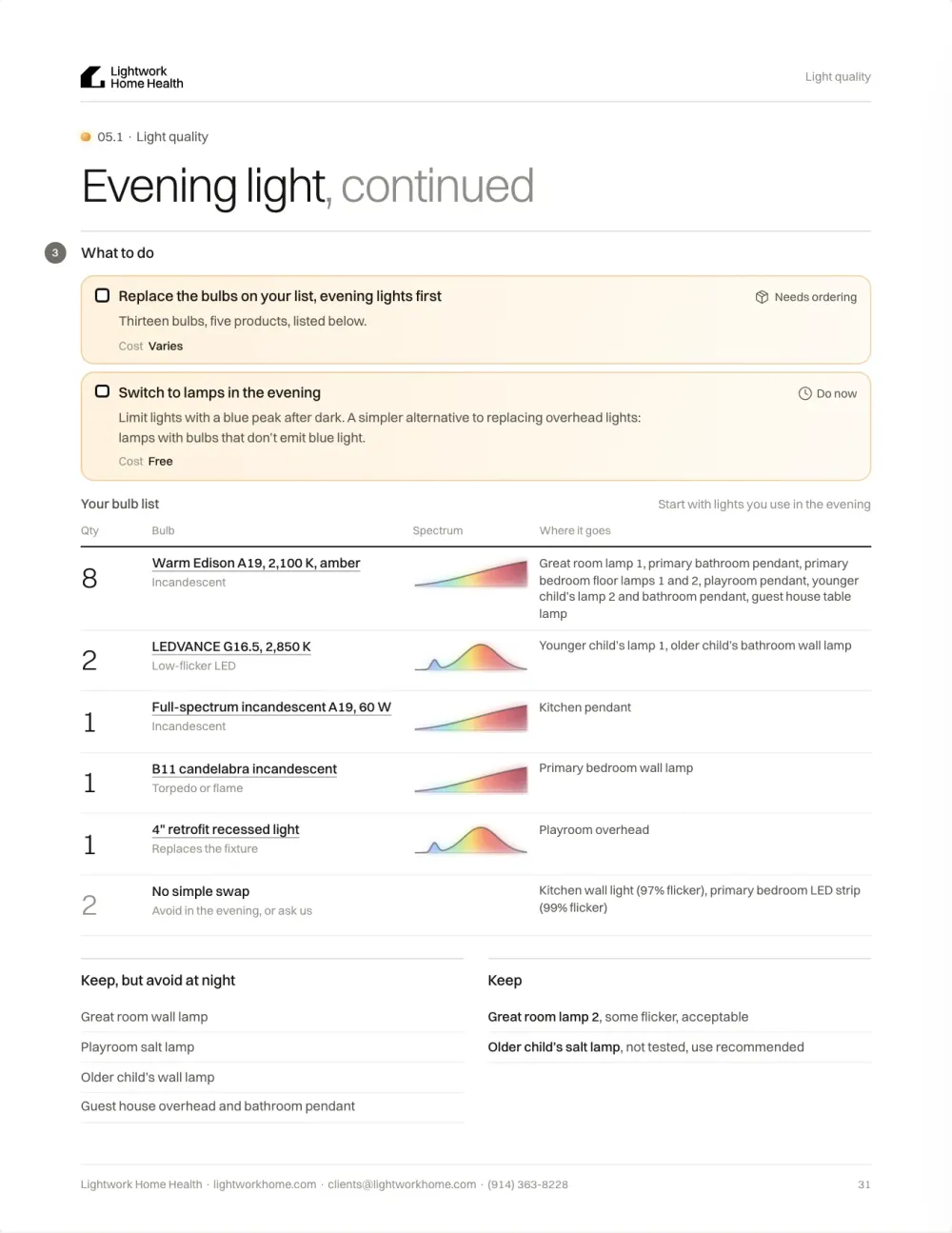
    A bulb list with exact products, quantities, and where each goes, plus simple changes like lamps instead of overheads in the evening.

What you get

Your results, light by light, in your Lightwork report.

The Evening light section of a sample Lightwork report, first page.The Evening light section of a sample Lightwork report, second page.
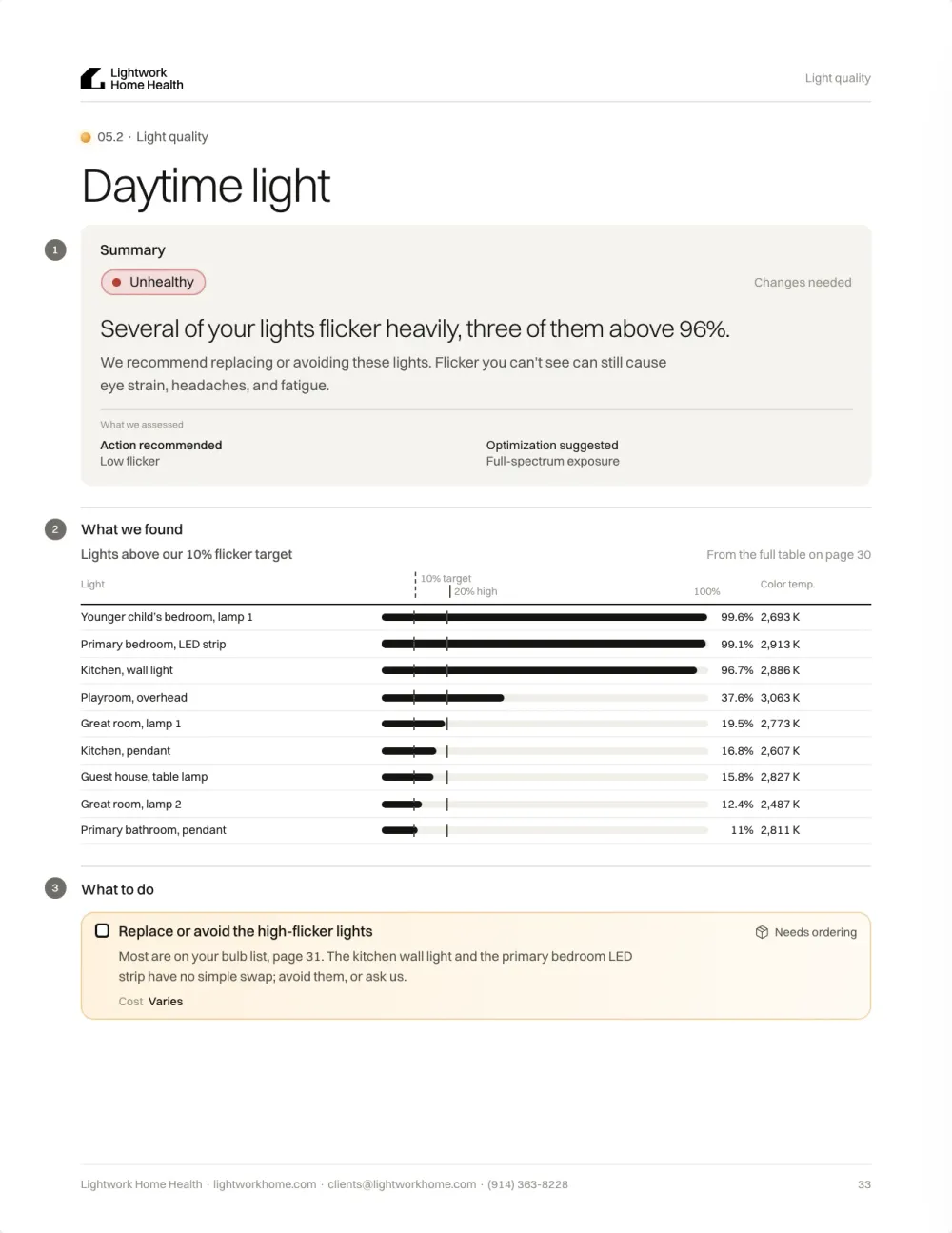
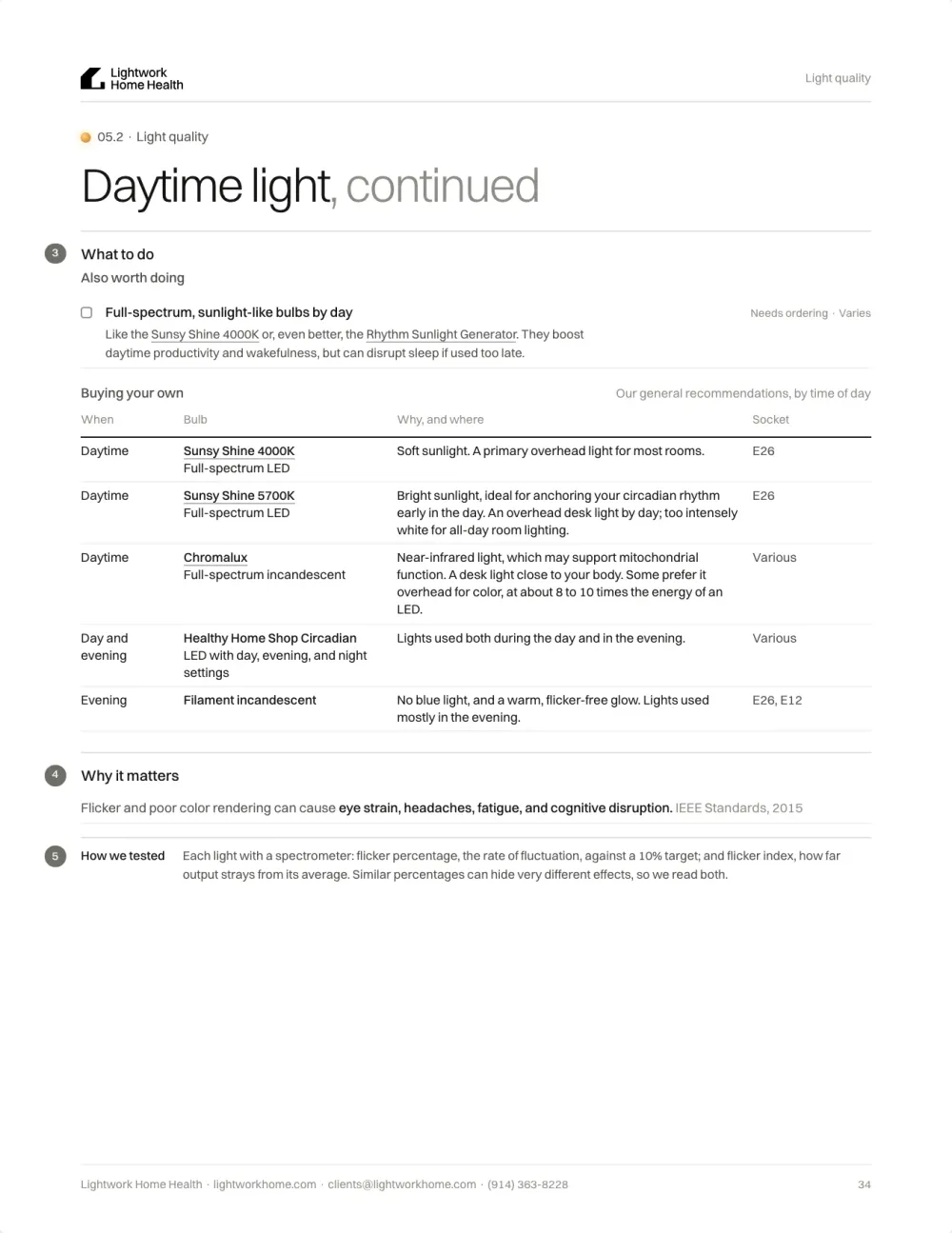
The Daytime light section of a sample Lightwork report, first page.The Daytime light section of a sample Lightwork report, second page.

Find out what the light in your home is doing.

We walk through your home, measure every light, and give you a short list of changes — alongside all the other possible environmental toxins present.

Schedule a free consultation →HSA/FSA eligible · Serving homes across the U.S., Canada, and Europe
References

Bibliography

  1. 1Prayag et al. (2019). Melatonin suppression is exquisitely sensitive to light and primarily driven by melanopsin in humans. J Pineal Res. Modelling of Brainard dataset, validated against new lab data. Paper ↗
  2. 2Wright et al. (2013). Entrainment of the human circadian clock to the natural light-dark cycle. Curr Biol. Field study, a week of summer camping with only natural light vs modern electrical lighting. Paper ↗
  3. 3He et al. (2015). Effect of time spent outdoors at school on the development of myopia among children in China: a randomized clinical trial. JAMA. Cluster RCT, 12 schools, n=1,903 first-graders, 3 years. Paper ↗
  4. 4Menegaz de Almeida et al. (2025). Bright light therapy for nonseasonal depressive disorders: a systematic review and meta-analysis. JAMA Psychiatry. Meta-analysis of 11 RCTs, 858 patients. Paper ↗
  5. 5Riemersma-van der Lek et al. (2008). Effect of bright light and melatonin on cognitive and noncognitive function in elderly residents of group care facilities: a randomized controlled trial. JAMA. Long-term double-blind 2x2 factorial RCT, n=189 in 12 care facilities, mean 15 months. Paper ↗
  6. 6Gooley et al. (2011). Exposure to room light before bedtime suppresses melatonin onset and shortens melatonin duration in humans. J Clin Endocrinol Metab. Retrospective analysis of controlled lab protocols, n=116 healthy adults 18 to 30. Paper ↗
  7. 7Hartstein et al. (2022). High sensitivity of melatonin suppression response to evening light in preschool-aged children. J Pineal Res. In-home experimental protocol, n=36 children aged 3 to 4.9, 1 h light at one of 15 levels (5 to 5,000 lux) before bedtime. Paper ↗
  8. 8Windred et al. (2024). Personal light exposure patterns and incidence of type 2 diabetes: analysis of 13 million hours of light sensor data and 670,000 person-years of prospective observation. Lancet Reg Health Eur. UK Biobank prospective cohort, n=84,790 with one week of wrist light sensing, 1,997 incident cases over about 8 years. Paper ↗
  9. 9Windred et al. (2025). Light exposure at night and cardiovascular disease incidence. JAMA Netw Open. UK Biobank prospective cohort, n=88,905 with wrist light sensors, 9.5 years of records. Paper ↗
  10. 10Deprato et al. (2025). Associations between light at night and mental health: a systematic review and meta-analysis. Sci Total Environ. Meta-analysis of 19 studies, 556,861 people. Paper ↗
  11. 11IARC (2019). Carcinogenicity of night shift work. Lancet Oncol. IARC expert working group evaluation. Paper ↗
  12. 12Travis et al. (2016). Night Shift Work and Breast Cancer Incidence: Three Prospective Studies and Meta-analysis of Published Studies. J Natl Cancer Inst. Paper ↗
  13. 13Miller et al. (2024). Visibility and annoyance of the phantom array effect varies with age and history of migraine. Lighting Research and Technology. Lab study, n=55 (25 with migraine), 85 LED modulation waveforms. Paper ↗
  14. 14Laycox et al. (2024). Flicker and reading speed: Effects on individuals with visual sensitivity. Perception. Two controlled LED-light experiments; Adults grouped by pattern-glare sensitivity. Paper ↗
  15. 15Brainard et al. (2001). Action spectrum for melatonin regulation in humans: evidence for a novel circadian photoreceptor. J Neurosci. 627 nighttime melatonin suppression tests in 72 healthy adults, monochromatic light 420 to 600 nm. Paper ↗
  16. 16Thapan et al. (2001). An action spectrum for melatonin suppression: evidence for a novel non-rod, non-cone photoreceptor system in humans. J Physiol. 215 light exposure trials in 22 volunteers, six wavelengths. Paper ↗
  17. 17Smith et al. (2004). Adaptation of human pineal melatonin suppression by recent photic history. J Clin Endocrinol Metab. Within-subject lab study, n=8, about 3 days of 200 lux vs 0.5 lux daytime light before a fixed 200 lux evening stimulus. Paper ↗
  18. 18Obayashi et al. (2022). Associations between indoor light pollution and unhealthy outcomes in 2,947 adults: cross-sectional analysis in the HEIJO-KYO cohort. Environ Res. Cross-sectional, n=2,947 (mean age 69), bedroom light meters. Paper ↗
  19. 19Obayashi et al. (2018). Bedroom light exposure at night and the incidence of depressive symptoms: a longitudinal study of the HEIJO-KYO cohort. Am J Epidemiol. Prospective cohort, n=863 older adults without depression at baseline, median 24 months. Paper ↗
  20. 20Obayashi et al. (2020). Bedroom lighting environment and incident diabetes mellitus: a longitudinal study of the HEIJO-KYO cohort. Sleep Med. Prospective cohort, n=678 older adults, bedroom light meters, median 42 months follow-up. Paper ↗
  21. 21Phillips et al. (2019). High sensitivity and interindividual variability in the response of the human circadian system to evening light. PNAS. Within-subject lab dose-response study, n=55 adults aged 18 to 30, 10 to 2,000 lux for 5 h in the evening. Paper ↗
  22. 22Mason et al. (2022). Light exposure during sleep impairs cardiometabolic function. PNAS. Randomized parallel-group lab study, n=20 healthy young adults. Paper ↗
  23. 23Wu et al. (2018). Myopia prevention and outdoor light intensity in a school-based cluster randomized trial. Ophthalmology. Cluster RCT, 16 schools, n=693 first-graders in Taiwan, 1 year. Paper ↗
  24. 24Lam et al. (2016). Efficacy of bright light treatment, fluoxetine, and the combination in patients with nonseasonal major depressive disorder: a randomized clinical trial. JAMA Psychiatry. Double-blind, placebo and sham-controlled RCT, n=122, 8 weeks. Paper ↗
  25. 25Xiong et al. (2017). Time spent in outdoor activities in relation to myopia prevention and control: a meta-analysis and systematic review. Acta Ophthalmol. Meta-analysis of 25 studies. Paper ↗
  26. 26Burns et al. (2021). Time spent in outdoor light is associated with mood, sleep, and circadian rhythm-related outcomes: a cross-sectional and longitudinal study in over 400,000 UK Biobank participants. J Affect Disord. UK Biobank, about 400,000 adults, cross-sectional plus longitudinal. Paper ↗
  27. 27Burns et al. (2023). Day and night light exposure are associated with psychiatric disorders: an objective light study in >85,000 people. Nature Mental Health. UK Biobank cross-sectional, n=86,772 with wrist light sensors. Paper ↗
  28. 28Viola et al. (2008). Blue-enriched white light in the workplace improves self-reported alertness, performance and sleep quality. Scand J Work Environ Health. Crossover field intervention, 94 office workers, 4 weeks each of 17,000 K vs 4,000 K light. Paper ↗
  29. 29Legenbauer et al. (2024). Bright Light Therapy as Add-On to Inpatient Treatment in Youth With Moderate to Severe Depression: A Randomized Clinical Trial. JAMA Psychiatry. Multicentre placebo-controlled randomized trial; 227 adolescents randomized; 224 in intention-to-treat analyses. Paper ↗
  30. 30Aini et al. (2024). The effects of light therapy on sleep, depression, neuropsychiatric behaviors, and cognition among people living with dementia: a meta-analysis of randomized controlled trials. Am J Geriatr Psychiatry. Meta-analysis of 24 RCTs, 1,074 participants. Paper ↗
  31. 31Li et al. (2026). Home-based tailored light therapy for sleep, mood, and cognitive outcomes in mild cognitive impairment: a randomized trial. J Appl Gerontol. Placebo-controlled RCT, n=61 people with MCI, 24 weeks of home lighting. Paper ↗
  32. 32Windred et al. (2024). Brighter nights and darker days predict higher mortality risk: a prospective analysis of personal light exposure in >88,000 individuals. PNAS. UK Biobank prospective cohort, n=88,905, mean 8 years follow-up, 3,750 deaths. Paper ↗
  33. 33Chang et al. (2015). Evening use of light-emitting eReaders negatively affects sleep, circadian timing, and next-morning alertness. PNAS. Randomized crossover lab study, light-emitting eBook vs printed book before bed. Paper ↗
  34. 34Brown et al. (2022). Recommendations for daytime, evening, and nighttime indoor light exposure to best support physiology, sleep, and wakefulness in healthy adults. PLoS Biol. International expert consensus (18 authors). Paper ↗
  35. 35Chellappa et al. (2013). Acute exposure to evening blue-enriched light impacts on human sleep. J Sleep Res. Lab study, n=30, 2 h evening light at 6500 K vs 2500 K vs 3000 K. Paper ↗
  36. 36Crowley et al. (2015). Increased sensitivity of the circadian system to light in early/mid-puberty. J Clin Endocrinol Metab. Lab study, 67 adolescents aged 9 to 16, 15 to 500 lux. Paper ↗
  37. 37Hartstein et al. (2025). The Circadian Response to Evening Light Spectra in Early Childhood: Preliminary Insights. Journal of Biological Rhythms. Counterbalanced within-child crossover; 10 children aged 3.0–5.9 years. Paper ↗
  38. 38Glickman et al. (2026). Quantifying the biological impacts of nightlights: implications for sleep and circadian health in children. NPJ Biol Timing Sleep. Spectral measurement of 25 popular nightlights (79 settings), source-level and simulated bedroom. Paper ↗
  39. 39Akacem et al. (2018). Sensitivity of the circadian system to evening bright light in preschool-age children. Physiological Reports. Within-child controlled light exposure; 10 children aged 3–5 years. Paper ↗
  40. 40Zhang et al. (2026). Light pollution and risk of diabetes: a systematic review and meta-analysis of observational studies. Front Public Health. Meta-analysis of 6 observational studies (645,010 participants). Paper ↗
  41. 41Kim et al. (2023). Light at night in older age is associated with obesity, diabetes, and hypertension. Sleep. Cross-sectional, n=552 community-dwelling US adults aged 63 to 84, 7-day actigraphy. Paper ↗
  42. 42Park et al. (2019). Association of exposure to artificial light at night while sleeping with risk of obesity in women. JAMA Intern Med. Sister Study cohort, n=43,722 US women, mean 5.7 years follow-up. Paper ↗
  43. 43Dai et al. (2026). Nighttime light exposure and cardiac structure and function. European Heart Journal. Prospective cohort with cardiac MRI; 11,071 UK Biobank imaging participants; 73,286 in outcome analyses. Paper ↗
  44. 44Obayashi et al. (2014). Association between light exposure at night and nighttime blood pressure in the elderly independent of nocturnal urinary melatonin excretion. Chronobiol Int. Cross-sectional, n=528 older adults, bedroom light meters plus ambulatory BP. Paper ↗
  45. 45Obayashi et al. (2019). Indoor light pollution and progression of carotid atherosclerosis: a longitudinal study of the HEIJO-KYO cohort. Environ Int. Longitudinal cohort, n=989 older adults, median 34 months follow-up. Paper ↗
  46. 46Chen et al. (2024). Artificial light at night and risk of depression: a systematic review and meta-analysis. Environ Health Prev Med. Meta-analysis of 7 studies, 560,219 participants. Paper ↗
  47. 47Esaki et al. (2022). Effect of nighttime bedroom light exposure on mood episode relapses in bipolar disorder. Acta Psychiatr Scand. Prospective cohort, n=172 outpatients with bipolar disorder, 7 nights of bedroom photometry, 2-year follow-up. Paper ↗
  48. 48Urbano et al. (2021). Light at night and risk of breast cancer: a systematic review and dose-response meta-analysis. Int J Health Geogr. Dose-response meta-analysis of 17 studies. Paper ↗
  49. 49Palomar-Cros et al. (2024). Indoor and outdoor artificial light-at-night (ALAN) and cancer risk: a systematic review and meta-analysis of multiple cancer sites and with a critical appraisal of exposure assessment. Sci Total Environ. Systematic review of 28 studies (2.5 million people), meta-analysis of 20 breast and 2 prostate studies. Paper ↗
  50. 50Greco et al. (2023). Wearing an eye mask during overnight sleep improves episodic learning and alertness. Sleep. Within-subject crossover, Experiment 1 n=94 (one week with mask vs one week without), Experiment 2 n=35 with sleep monitoring. Paper ↗
  51. 51Miller et al. (2022). Flicker: a review of temporal light modulation stimulus, responses, and measures. Lighting Research and Technology. Narrative review (US DOE-funded). Paper ↗
  52. 52Wilkins et al. (1989). Fluorescent lighting, headaches and eyestrain. Lighting Research and Technology. Double-blind crossover in offices, 100 Hz flicker (43% to 49% modulation) vs high-frequency ballasts (about 32 kHz, under 7% modulation). Paper ↗
  53. 53IEEE Std 1789 (2015). IEEE recommended practices for modulating current in high-brightness LEDs for mitigating health risks to viewers. IEEE recommended practice. Standards body recommended practice. Paper ↗
  54. 54Fisher et al. (2005). Photic- and pattern-induced seizures: a review for the Epilepsy Foundation of America Working Group. Epilepsia. Expert consensus review. Paper ↗
  55. 55Veitch and Miller (2024). Effects of Temporal Light Modulation on Individuals Sensitive to Pattern Glare. LEUKOS. Subgroup reanalysis of experimental data; Participants with high versus low pattern-glare sensitivity. Paper ↗
  56. 56Knez (2014). Affective and cognitive reactions to subliminal flicker from fluorescent lighting. Consciousness and Cognition. Randomized laboratory experiment; Human participants exposed to fluorescent lighting conditions. Paper ↗
Journal

Recent posts.

All posts
Lighting

All light is not created equal

March 28, 2025 · 19 min read

Learn how light spectrum and flicker can affect circadian rhythm, sleep, and comfort, plus how to choose healthier lighting at home.

Lighting

It’s illegal to buy healthy lightbulbs in California

October 19, 2024 · 8 min read

If you want light that doesn’t disrupt your circadian rhythm, you’re out of luck in California.

Find out what the light in your home is doing.

We walk through your home, measure every light, and give you a short list of changes — alongside all the other possible environmental toxins present.

Schedule a free consultation →
The science of the rest of your home Air → Water → Light You're here Fields Coming soon Mold Coming soon Chemicals Coming soon Sound Coming soon

Schedule a complimentary consultation

We will help you find out what’s going on in your home and turn it into a foundation for wellbeing and longevity.